
For many homeowners, the dream of a luxury indoor pool begins with one crucial question:
Can I build my pool under Permitted Development?
The good news? In many cases, the answer is yes.
Under Permitted Development (PD) rules, you may be able to build an indoor pool or pool house without going through the full planning application process, provided your project meets certain criteria. The answer depends on where and how you plan to build and whether your pool house will sit stand-alone in your garden or form an extension of your home.
What is permitted development
Permitted Development is a national planning policy that allows homeowners to carry out certain types of building work without the need for formal planning permission. It was designed to simplify improvements and extensions to private homes - including outbuildings like garages, garden rooms, and, yes, pool houses.
Most stand-alone indoor pool buildings fall under Class E of the planning rules, which covers structures "reasonably required for the enjoyment of the dwelling." That means if your pool is for personal use and the design sits within specific limits, it may qualify for PD rights. However, extensions that connect directly to the main home usually fall under Class A, where the rules differ slightly.
Understanding which category your pool fits into helps determine whether PD applies.
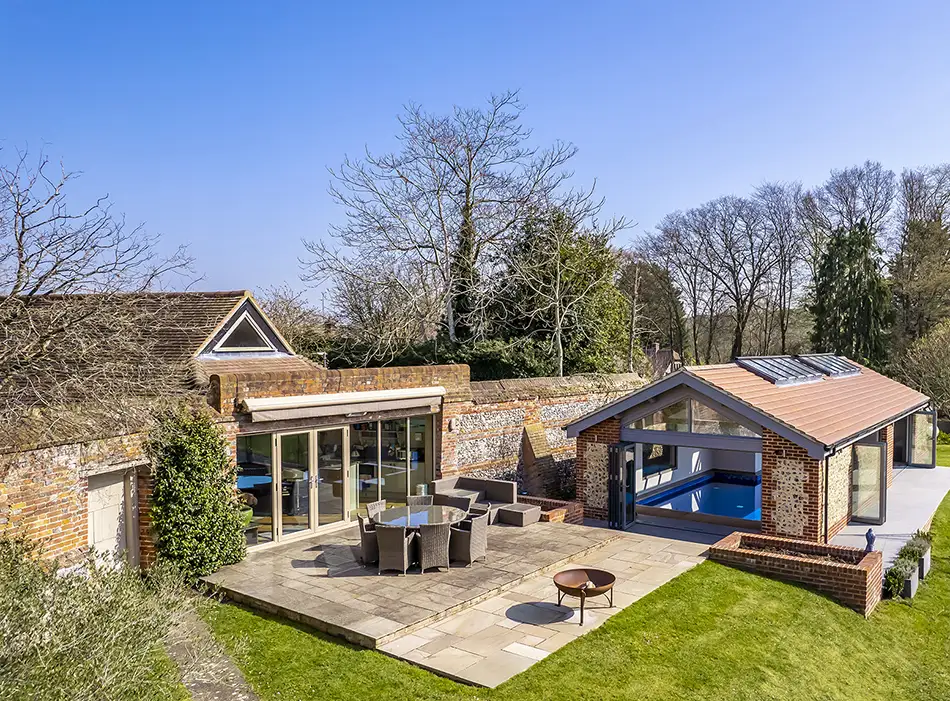
Category 1: Stand-alone pool houses (Class E)
A stand-alone pool house is separate from your main home, often built within the garden or grounds. These structures can often be built under Class E Permitted Development, provided they meet certain criteria:
- Located within the curtilage (garden) of your main house.
- Used solely for domestic enjoyment, not as accommodation or a business.
- Not forward of the principal elevation (the front of your home).
- Maximum height of 4 m with a dual-pitched roof, or 3 m for other roof types. Eaves height of no more than 2.5 m.
- Maximum height of 2.5 m if within 2 m of a boundary.
- Combined outbuildings (including garages or sheds) occupy less than 50% of the total garden area.
- The proposed structure must be single-storey.
If your proposed pool house fits within these limits, it may qualify as Permitted Development, meaning you won’t need a full planning application.
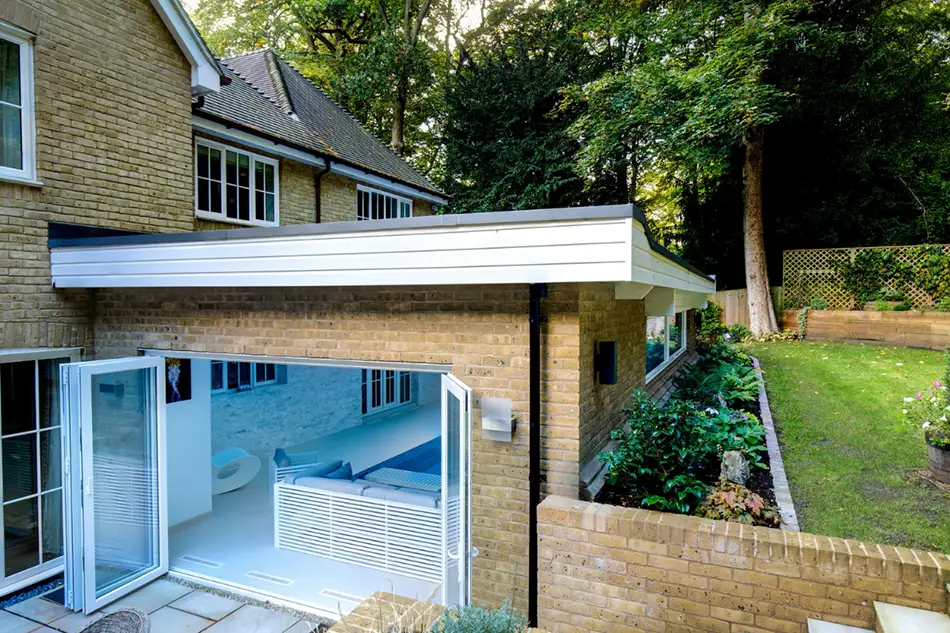
Category 2: Attached pool houses or extensions (Class A)
If your pool forms part of an extension to your home, different PD rules apply under Class A.
In this case, planning permission may still be avoided, but stricter conditions govern size, placement and design:
- Single-storey extensions must not extend more than 4 m beyond the rear wall of a detached house (3 m for semi-detached or terraced homes).
- The total height must not exceed 4 m.
- Materials must be similar in appearance to the existing house.
- No balconies, verandas or raised platforms are permitted under PD.
If your proposed pool connects directly to your main house, through a shared wall, roofline or internal access, it’s usually treated as an extension and a planning application may be the safer route.
Criteria | Class E | Class A |
|---|---|---|
Location |
Within the garden (curtilage) |
Attached to the main house |
Position on site | Not forward of front elevation | Rear or side of house |
Purpose | Leisure |
Ancillary to home |
Height limit |
4m dual pitch / 3m flat roof |
Max 4m total height |
Distance to boundary |
2.5m if within 2m boundary |
No distance rule |
Garden coverage |
Less than 50% of garden area |
Rear projection limits (3-4m) |
Materials |
Flexible external finishes |
Must be similar to existing house |
Planning likelihood |
Often PD compliant | Most likely requires planning |
When planning permission is still required
Even if your project meets most PD rules, you may still need planning permission if:
- Your home is listed, in a conservation area or in designated land (e.g. National Parks, AONBs).
- Your site has already used up its PD allocation with previous outbuildings.
- You want to include living accommodation or commercial use within the building.
- You have had PD rights specifically removed under an Article 4 Directive.
In these cases, Origin’s in-house design and planning team will prepare and manage a full planning application on your behalf, ensuring every detail meets local policy and national building regulations.
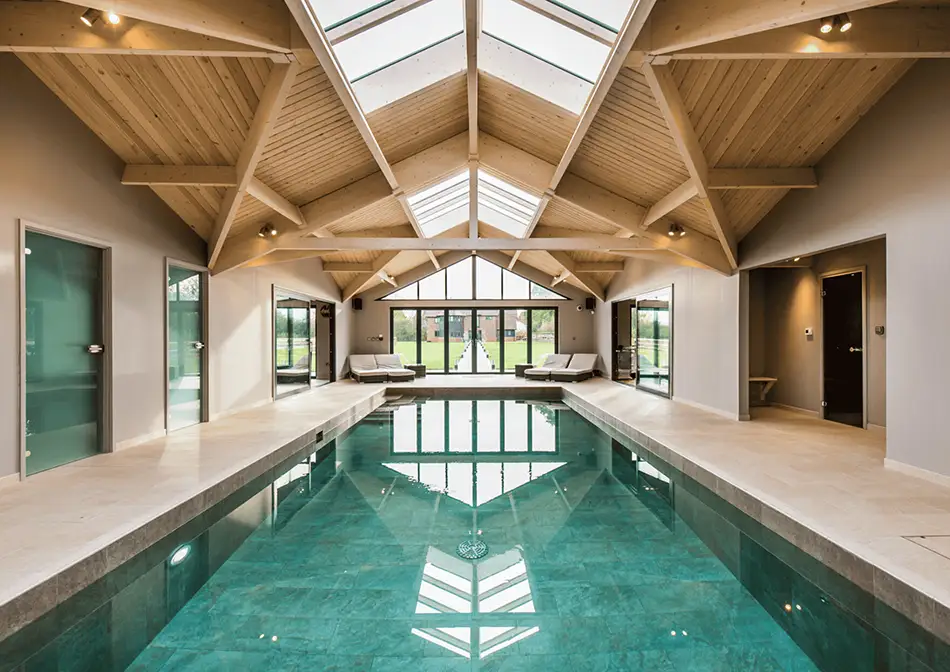
How Origin simplifies the process
At Origin, we don’t expect you to navigate planning law alone. Our planning and design experts assess every project individually, providing clear advice before any drawings are produced.
If your pool qualifies under Permitted Development, we’ll prepare a Certificate of Lawfulness, so as to seek formal evidence the build can proceed without Planning Permission.
If planning is required, we’ll handle the entire process: design documentation, drawings, energy assessments and council submission.
The result? Total peace of mind, whichever route your pool follows.
A smarter start to indoor pool ownership
Understanding your pool planning permission options early ensures your project moves forward without uncertainty or delay.
Certain Origin designs, such as the Signature Range - VIDA 50, SOLIS 65 and ÉLAN 80 - have been carefully engineered to align with Permitted Development parameters wherever possible, giving you greater clarity from day one.
However, whether you choose an existing design, go Bespoke or have a stand-alone or connected pool, Origin’s expertise ensures that compliance, design excellence and peace of mind come as standard.
Discover if your dream pool qualifies for Permitted Development.
Book your personal planning consultation with Origin’s design team.
 Locations Covered